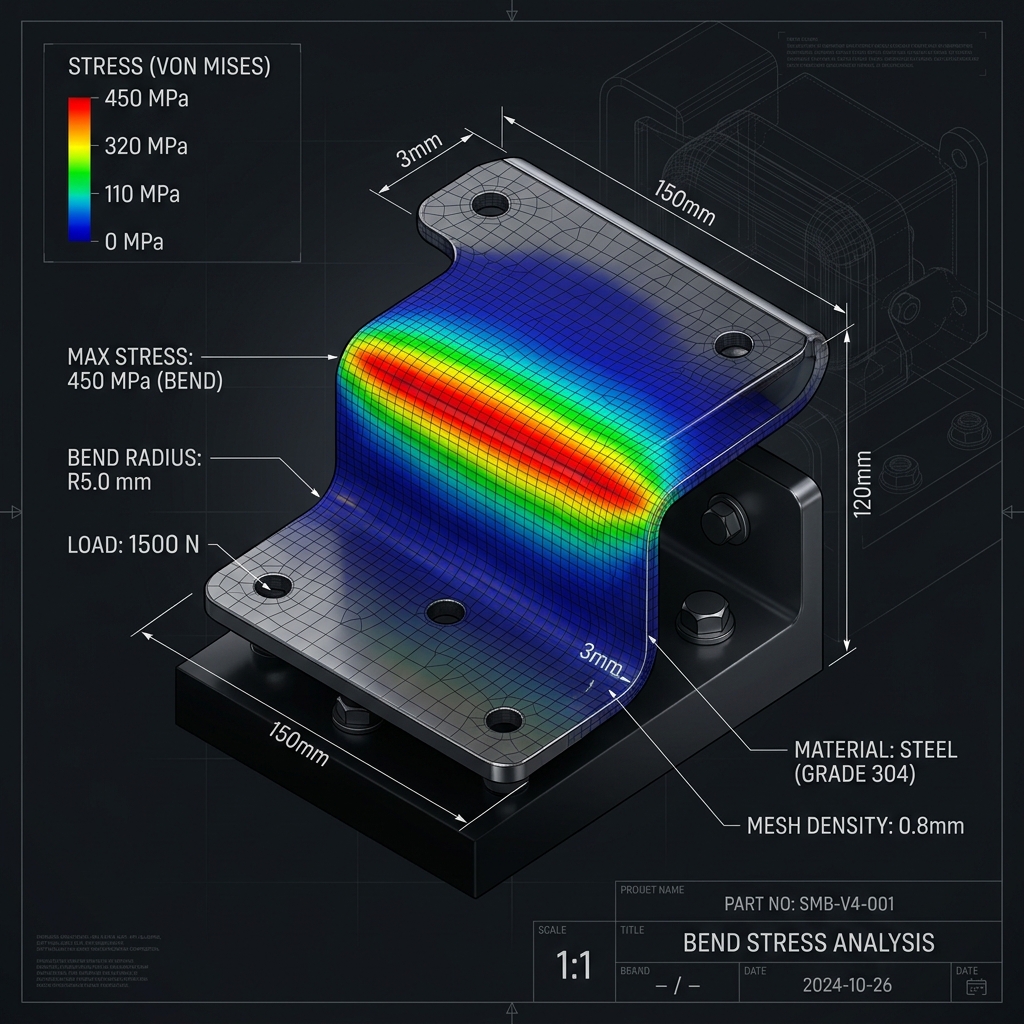
Pulling a finished sheet metal part off the press brake only to find a fracture running along the bend line is a frustrating, costly setback. The CAD model looked perfect, and the material specs seemed right—yet the part still failed.
Bend failures aren't random anomalies. They follow predictable patterns governed by metallurgy and process physics. Once you isolate the root causes, these defects become entirely preventable. This guide breaks down exactly why sheet metal cracks or deforms in the bend zone, delivering actionable, empirical data your design team can use immediately.
For an in-depth production walkthrough, the engineering team at Tesla Mechanical Designs provides a comprehensive technical analysis here: Why Does Our Sheet Metal Part Keep Failing at the Bend, and How Do We Fix It?
Why the Bend Zone Fails First
When a sheet is bent, the outer surface is pulled in tension while the inner surface is compressed. The material must handle both forces simultaneously across a very small zone. If the bend radius is too tight for the material's ductility, the outer fibers exceed their elongation limit: Xometry Sheet Metal Bending Basics—and that's where cracking begins.
Understanding this mechanism is essential because every fix ultimately traces back to reducing or redistributing that stress.
The Most Common Causes - With Accurate Numbers
1. Bend Radius Too Tight for the Material
This is the leading cause of bend failure, and the minimum radius is not the same for every material. Industry standards—including Machinery's Handbook (31st Edition)—specify different ratios based on material type and thickness:
| Material | Minimum Bend Radius (per thickness "t") |
|---|---|
| Mild Steel (A36/1018) | 0.8-1× t (perpendicular to grain) |
| Stainless Steel 304/316 | 1.5-2× t (up to 3× t for plate >6mm) |
| Aluminum 5052-H32 | 1.5-2× t (production-safe guideline; 1×t possible on thin gauges across grain in ideal conditions) |
| Aluminum 6061-T6 | 2-3× t thin gauges; 4-6× t for thicker stock (brittle temper - always verify with supplier) |
Going below these values risks fractures on the outer tension face—detectable by penetrant testing after forming. As a practical rule, when in doubt, go larger. The cost of a slightly larger radius is far less than scrap and rework.
Important: These are production-safe starting guidelines based on Machinery's Handbook (31st Ed.), ASM Handbook Vol. 14B, and FMA press brake standards. Actual minimum values vary by specific material grade, temper, heat lot, and grain orientation. Always verify against your material supplier's certified data sheet before finalizing a design—especially for safety-critical or high-volume applications.
2. Bending Parallel to the Grain Direction
Sheet metal is rolled during manufacturing, which creates a directional grain structure. Bending parallel to the grain concentrates stress along the fiber direction, dramatically increasing crack risk—especially in aluminum and high-strength steels.
The fix is simple in design: orient your blank so the bend line runs perpendicular to the rolling direction. In thick structural steel (grades 350-400), bending parallel to grain can require a minimum radius up to 3.75× the material thickness—nearly double the transverse bending requirement.
The Fabricator — Minimum Inside Bend Radius vs. What's Recommended (Steve Benson, FMA)
3. Incorrect V-Die Opening
The V-die opening controls how bending force is distributed. Use one that's too narrow and you concentrate excessive stress, cause die marks, and risk cracking.
The industry-standard starting point:
- Mild steel: V-die opening = 8× material thickness (produces an inside radius ≈ material thickness)
- Stainless steel: 8-12× material thickness (higher springback demands a wider opening)
- Soft aluminum: 6× material thickness is often acceptable
For a 3mm mild steel sheet, that means an 18-24mm die opening as a baseline, adjusted from there based on material grade and punch radius.
4. Poor Material Quality
Low-grade material can contain internal voids, manganese sulfide inclusions, or surface contamination that create hidden weak points exactly where bending stress concentrates. If your parts are failing with irregular fracture patterns under examination—especially with voids running longitudinally near the outer radius—the material is likely the root cause, not the process.
Sourcing certified material with documented mechanical properties (elongation, yield strength, tensile reduction %) costs more upfront but almost always costs less overall once you account for scrap rates and rework labor.
5. Coining When Air Forming Is the Better Choice
Coining (where the punch forces the material fully into the die) can produce sharp bends but places enormous stress on both the material and the machine. The die marks on your parts are often the first symptom of excessive coining pressure.
Air forming—where the material contacts only the punch tip and die shoulders, with the radius floating naturally—is the standard for most structural and precision applications. It requires significantly less tonnage, preserves material integrity, and with a properly matched punch nose radius produces bends equivalent in quality to coining for the vast majority of use cases.
Springback: The Numbers Behind the Compensation
Springback is elastic recovery after the punch retracts. It isn't just an angle accuracy problem—persistent mismatch between process springback and compensation indicates a deeper setup issue.
Typical springback values at 90° (from industry formulas based on DIN 6935 and FMA press brake standards):
| Material | Typical Springback at 90° |
|---|---|
| Mild steel (A36/S275) | 2-3° |
| Structural steel S355 | 3-5° |
| Stainless steel 304/316 | 6-8° |
| Duplex stainless 2205 | 8-12° |
| Aluminum 6061-T6 | Up to 12° (requires individual test bends) |
These values assume a 1:1 inside radius-to-thickness ratio in air forming. Critically: springback increases sharply as the inside radius grows relative to material thickness. A large-radius bend in high-strength steel can require 15-30° of overbend compensation. CNC press brakes with real-time angle measurement handle this systematically, which is one of the strongest arguments for modern CNC equipment in production environments.
Design Rules That Prevent Bend-Zone Failures
Hole-to-bend-line distance: Placing holes too close to a bend line is one of the most common and costly DFM errors. The bending force deforms material for roughly 2× thickness on each side of the bend line. Any hole within that zone will distort—stretching from round into oval and shifting out of position.
Industry DFM guidelines vary slightly by source—ranging from 2×t to 4×t depending on the application and fabricator standard. A reliable, broadly accepted minimum: hole edge at least 2-3× material thickness from the bend line for general fabrication; safety-critical or precision applications should use 3×t or more. If your design requires a hole closer than that, drill it after forming as a secondary operation.
Bend relief cuts: When a bend runs to a corner, add relief notches at the bend line ends. Relief width should be at least equal to the material thickness (minimum 0.5×t, though many fabricators recommend ≥1×t for reliability); relief depth should exceed the bend radius plus material thickness, with a small additional clearance of ~0.5mm (0.020"). Without relief cuts, the corner will tear or deform unpredictably. Note that different CAD platforms and fabricators use slightly different sizing conventions—always confirm with your fabrication partner.
Flange height minimum: Keep flange height above 3× material thickness—otherwise the punch can't engage the material properly and you'll get inconsistent, poorly formed bends.
Fixes That Actually Work
- Increase bend radius first. If parts are cracking, this is your primary adjustment. Check your material's actual minimum radius from supplier data—not a generic rule of thumb—and verify your current setup meets it with margin.
- Rotate for grain direction. If changing the grain orientation is possible in your blank layout, do it before adjusting any other parameter. It's the lowest-cost fix available.
- Switch to air forming. If you're coining to achieve a sharp radius, evaluate whether that radius is actually a functional requirement. Most aren't. Air forming with a matched punch radius produces equivalent results with far less risk.
- Upgrade material specification. Specifying material certifications (tensile strength, elongation %) adds modest cost but eliminates an entire category of unpredictable failures, especially on formed assemblies that will see cyclic loads.
- Anneal before bending. For work-hardened alloys or materials that are close to their minimum radius limits, controlled annealing restores ductility. It adds a process step but is often more practical than redesigning the part geometry.
- Inspect and replace worn tooling. A chipped or worn punch nose creates stress risers at the contact point that initiate cracking even when every other parameter is correct. High-volume operations should have scheduled tooling inspection intervals.
A Note on the Numbers in This Article
The figures in this post are drawn from Machinery's Handbook (31st Edition), ASM Handbook Vol. 14B, DIN 6935, FMA Precision Press Brake standards, and multiple verified fabrication industry sources. They represent production-safe guidelines—not theoretical minimums.
That said, sheet metal fabrication involves real-world variability. Actual minimum bend radii, springback values, and feature clearances can differ based on your specific material grade, temper, heat lot, tooling condition, and fabricator equipment. Treat every number here as a well-grounded starting point—and always validate against your material supplier's certified data and your fabrication partner's process capabilities before committing to production.
The Bottom Line
Bend failures in sheet metal fabrication consistently trace back to a small set of root causes: bend radius relative to material type, grain direction, die selection, forming method, and material quality. None are mysterious once you know the correct numbers for your specific material—and none require expensive solutions when caught at the design stage.
For a practical, production-focused guide to diagnosing and fixing bend failures, the Tesla Mechanical Designs team breaks down the full picture here: Why Does Our Sheet Metal Part Keep Failing at the Bend, and How Do We Fix It?
Getting bends right the first time isn't about luck or experience alone—it's about using the right specifications for your material and respecting what the physics of metal forming actually demands.