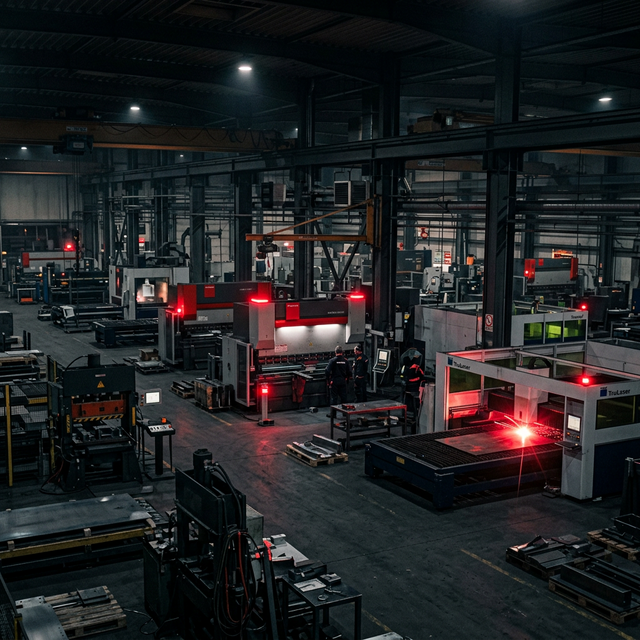
Exploring the direct link between highly detailed 2D/3D manufacturing drawings and reduced shop floor error rates.
Why Drafting Quality Still Matters
In an era of advanced CAM software and automated CNC machines, it's tempting to assume that 3D models alone are sufficient for manufacturing. But the reality on the shop floor tells a different story. Operators, quality inspectors, and assembly teams still rely heavily on 2D drawings for critical decisions — and the quality of those drawings directly impacts production outcomes.
The Cost of Ambiguous Drawings
Studies show that up to 40% of shop floor errors can be traced back to unclear or incomplete engineering drawings. Common issues include:
- Missing or inconsistent GD&T callouts
- Unclear datum references that leave tolerances open to interpretation
- Incomplete bill of materials (BOM) causing wrong parts to be ordered
- Poor section views that don't reveal internal features
- Missing surface finish specifications leading to extra processing steps
What Makes a Drawing "Production-Ready"
A production-ready drawing package goes far beyond dimensional accuracy. It serves as the single source of truth between the design office and the shop floor:
- Complete GD&T — Every critical feature has proper geometric tolerancing per ASME Y14.5
- Clear datum structure — Inspection teams can set up parts consistently every time
- Material and finish specs — No ambiguity about alloy grade, temper, or coating
- Revision control — Every change is tracked with clear revision blocks and ECN references
- Flat pattern views — For sheet metal, the flat pattern with bend notes is essential for laser/punch programming
3D Models as Supplements, Not Replacements
While 3D STEP and Parasolid files are invaluable for CNC programming, they cannot convey manufacturing intent the way a properly annotated drawing can. The ideal workflow combines both: the 3D model drives tool paths, while the 2D drawing governs quality inspection and assembly procedures.
The TMD Approach
At Tesla Mechanical Designs, every drawing package we deliver follows a rigorous internal checklist before release. Our drafters are trained in both ASME and ISO standards, and every drawing undergoes a peer review before it reaches your shop floor. The result: fewer RFIs, faster first-article approvals, and production runs that stay on schedule.