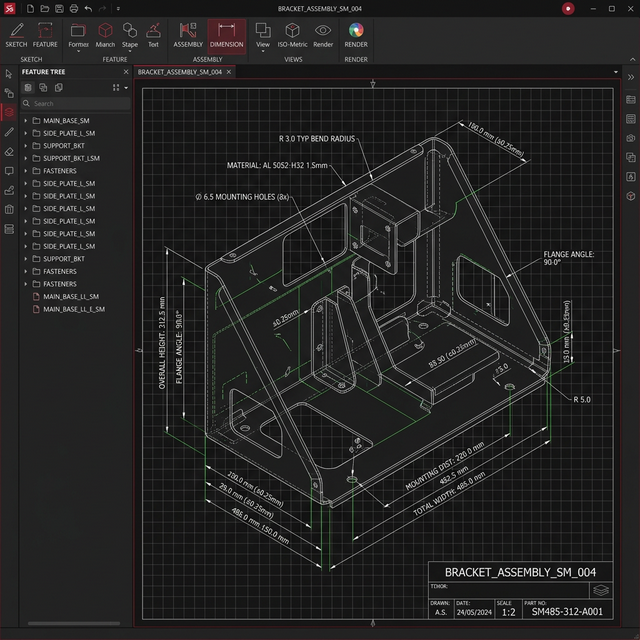
A deep dive into why relying solely on K-Factors isn't enough, and how accurate bend deductions ensure tolerance consistency.
The Problem with Generic K-Factors
When converting 3D models into flat patterns, understanding the difference between Bend Allowance and Bend Deduction is critical for determining precise blank sizes. Errors at the CAD level compound exponentially on the shop floor, leading to scrapped parts and blown budgets.
Most CAD software provides default K-Factor values (typically 0.44 for air bending), but these generic numbers rarely reflect real-world conditions. Material properties, grain direction, tooling radius, and press brake tonnage all influence the actual deformation zone.
Bend Allowance vs. Bend Deduction
Bend Allowance (BA) is the length of the neutral axis arc through the bend zone. It represents the amount of material consumed by the bend itself:
BA = π / 180 × Bend Angle × (Inside Radius + K-Factor × Material Thickness)
Bend Deduction (BD) is the difference between the total of the outside mold lines and the actual flat pattern length. It tells you how much to subtract from the total outside dimensions to get the correct flat size:
BD = 2 × (Inside Radius + Material Thickness) × tan(Bend Angle / 2) − BA
Why This Matters for DFM
In production runs, even a 0.5mm discrepancy in the flat pattern can cascade into:
- Misaligned hole patterns on assembly
- Interference fits in enclosure designs
- Failed tolerance stack-ups across multi-part assemblies
- Increased scrap rates and rework cycles
Best Practices
- Always request bend test data from your fabricator for the specific material and tooling combination
- Use measured K-Factors rather than software defaults whenever possible
- Validate flat patterns against physical prototypes before committing to production tooling
- Document all bend parameters in your drawing notes for shop floor clarity
Conclusion
Accurate bend calculations are the foundation of reliable sheet metal design. By investing time upfront in proper bend allowance and deduction analysis, you eliminate costly rework downstream and deliver parts that fit right the first time.